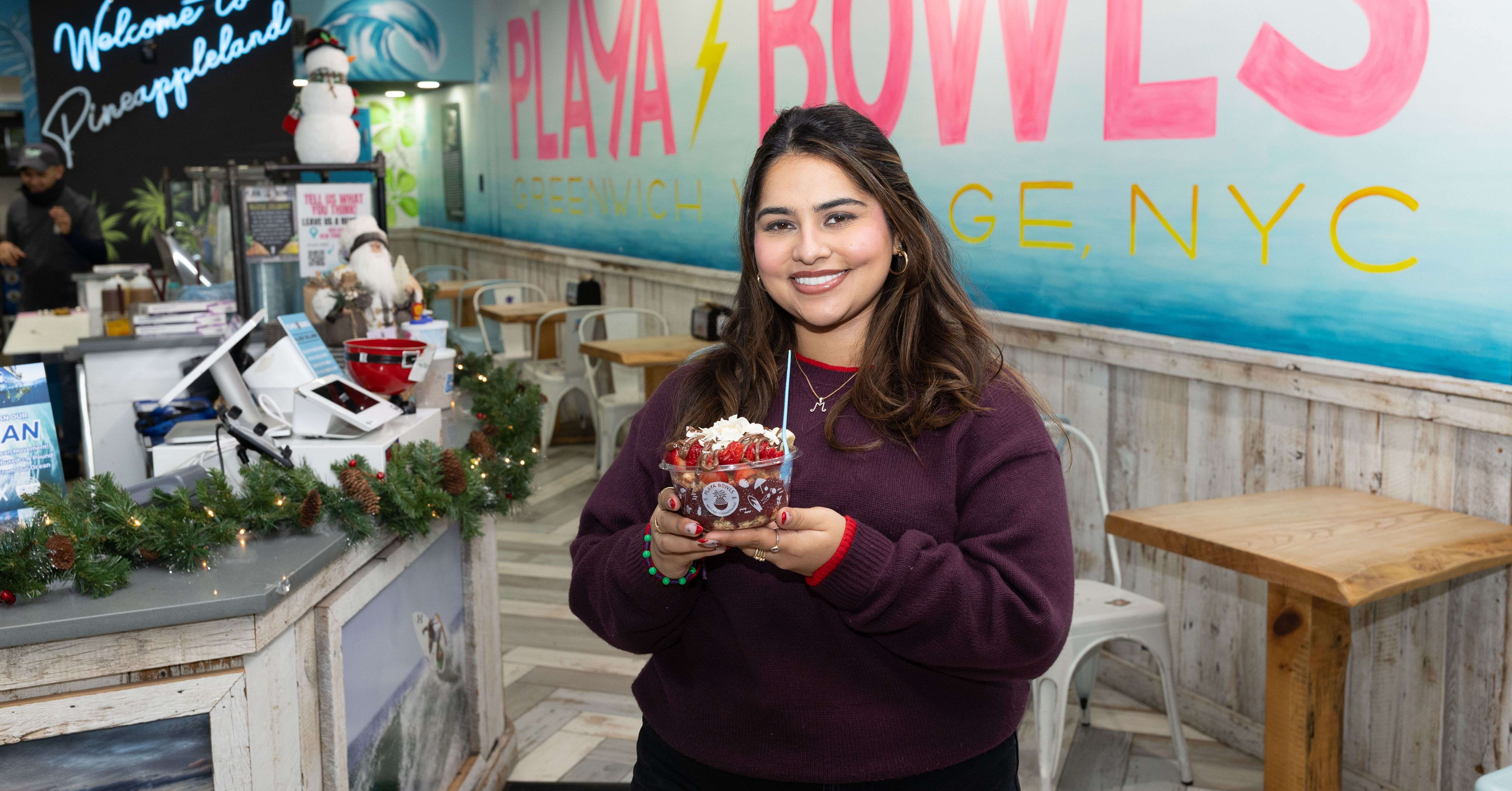
From First-Time Franchise Owner to 16 Shops: How One Operator Built a Scalable Playa Bowls Business

At 24, most people are still trying to figure out their career path, but Misha Punwani took a different route. She chose franchise ownership.
Instead of seeing her age as a limitation, she regarded it as an asset. She instinctively understood her target audience and identified an opportunity others hadn't fully capitalized on, expanding a growing, better-for-you concept deeper into New York City.
Identifying the Opportunity
When Punwani first explored Playa Bowls, the brand was already established in nearby New Jersey but was still underrepresented in Manhattan. In a dense, trend-driven market, that gap signaled opportunity.
She moved quickly, opening her first shop in the Wall Street area and taking over an existing company-owned location. From the start, her focus was clear: to create an experience that reflects how guests discover and engage with concepts today.
Her background as a digital media analyst shaped that approach. She viewed data not just as numbers but as insights into behavior, what guests respond to, how they make decisions, and what ultimately drives repeat visits.
Building a Repeatable Model
Growth did not come from a single strong location. It came from consistency.
Punwani focused on building the infrastructure within her own operating company to support scalable growth, ensuring consistency and repeatability across multiple shops. That infrastructure was reinforced by clear operating priorities:
- Keeping the guest experience simple and intuitive
- Prioritizing visual appeal and clarity in product presentation
- Maintaining consistent operations across locations
As her portfolio grew, she stayed closely involved in daily operations. She frequently visited multiple shops and reinforced expectations with her team members.
At the same time, she recognized that growth required delegation. Building strong leaders and keeping communication clear became vital to maintaining culture across her shops.
Scaling in a Competitive Market
New York City presents one of the most challenging operating environments in the country, particularly when it comes to real estate. Rather than seeing this as a barrier, Punwani viewed it as part of the process.
She approached site selection with patience and preparation. She understood that the right locations would become available over time and remained disciplined, avoiding sites that weren't the right long-term fit.
That discipline paid off. Her portfolio grew to 16 successful shops across Manhattan, Brooklyn, and Long Island. This shows that the Playa Bowls model can scale even in highly competitive markets.
The Role of Culture in Growth
As the business expanded, maintaining culture became a central focus.
Punwani led by example and worked alongside her team members in daily operations. She reinforced a simple principle: every role matters. This hands-on approach helped create alignment across shops and ensured consistency in the guest experience.
She also emphasized communication and fostered an environment where team members feel heard and appreciated. This approach directly leads to improved performance and greater guest satisfaction.
What This Means for Franchise Owners
Punwani’s experience highlights several important lessons for future franchise owners.
- Opportunities are often found where demand exists but remains underdeveloped.
- A strong brand can enable multi-unit growth when combined with disciplined execution.
- Systems, not individual shops, drive scalability
- Culture and leadership are essential for maintaining consistency.
Her growth from a first-time franchise owner to a 16-shop operator highlights what can be achieved within the Playa Bowls system when operators combine market awareness, operational discipline, and a clear long-term vision.
To learn more about the Playa Bowls franchise opportunity, visit the Playa Bowls franchising website.
You can also read a feature on Misha Punwani in Multi-Unit Franchisee Magazine.